The Question That Finds the Playable Script
Choose a playable script by naming your group’s non-negotiables, then compare cast, rehearsal time, rights and production capacity before you commit.
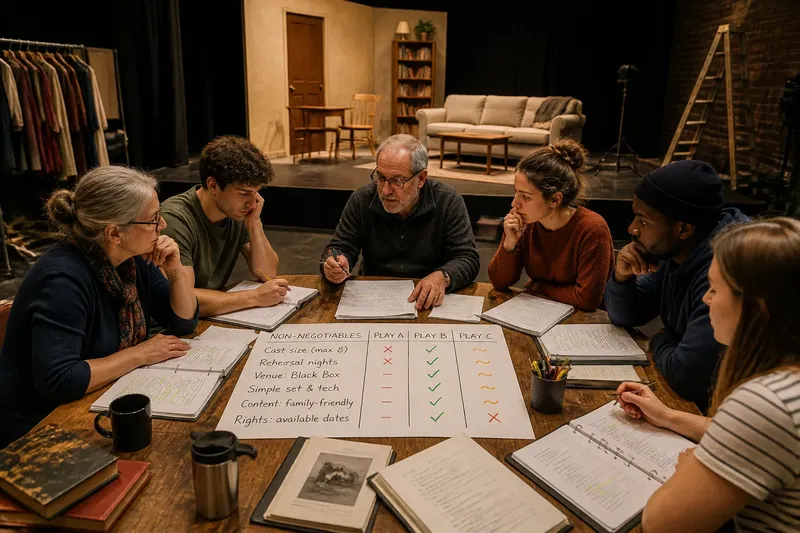
A playable script is one your group can stage with the people, time, and resources actually available. To choose a playable script, begin by naming what cannot change, then judge each candidate against those limits. That question is more useful than asking which play is simply the most exciting to read.
A script can be moving on the page and still ask for a cast you cannot assemble, a setting you cannot suggest, or a rehearsal commitment your members cannot sustain. None of those concerns automatically rules it out. They tell you where to look closely before the group falls in love with a production it cannot support.
What does your group need to protect?
Before browsing scripts, agree on a short list of non-negotiables. These are constraints, not preferences. A preference might be a comedy; a non-negotiable might be that the production has to fit the venue’s available dates.
Useful questions include:
- How many performers can reliably take part, and are there casting or doubling limits?
- What rehearsal period and attendance pattern can the group realistically manage?
- What venue is available, and what restrictions affect entrances, scenery, sound, or audience layout?
- What production skills and equipment can the group provide without relying on unavailable help?
- Are there content considerations the group needs to address for its community or intended audience?
- Can the group obtain performance rights for the proposed dates and venue?
Keep the list short enough to guide a decision. If every preference becomes a hard rule, you may reject scripts that could work with a sensible adjustment. If the list is too vague, such as “easy to stage,” it will not help you compare candidates.
Which situation sounds like your group?
If your cast size is settled, but the script’s casting is flexible: Look for a script whose roles can be assigned within your actual roster, including any doubling the text supports. Check how often actors need to be present together, not just the total number of named parts. This suits groups with a dependable core cast and limited room to add performers.
If your cast is still taking shape: Favor scripts with room for a range of performers, rather than a piece built around one unavailable specialty or a tightly interlocked ensemble. Confirm that the roles still make sense if a prospective actor withdraws. This fits a community group recruiting new members, but it is not a reason to assume a role can be removed without changing the play.
If rehearsal availability is the tightest limit: Consider scripts with a contained cast, few simultaneous scene demands, and material your group can rehearse without coordinating a large number of absences. Read the whole script for frequent entrances, complex transitions, or scenes that depend on many actors being present. A short play is not automatically a light rehearsal commitment.
If the venue or production capacity is fixed: Look for scripts whose staging can live comfortably within the space and resources you have. A flexible location or simple scenic world may be a better fit than a play that depends on a particular room, elaborate machinery, or complicated sound cues. Choose this route when borrowing, building, or operating extra equipment would put strain on the team.
If artistic ambition is the main driver: Keep the challenging script in consideration, but name the specific demands it creates and decide who can take responsibility for them. This suits a group with the relevant skills, time, and appetite for the work. It is a poor fit if the plan depends on vague promises that someone will “figure it out later.”
How do you compare scripts without guessing?
Put the non-negotiables at the top of a page, then give every candidate the same review. A simple three-mark system works: fits, needs a workable adjustment, or conflicts with a non-negotiable. Add a brief note beside each mark so the decision reflects evidence in the script rather than an impression from its premise.
For example, imagine a group has a small, confirmed cast, a compact room, and rehearsals on limited evenings. One candidate calls for a crowd scene and frequent changes of location; another uses a contained cast and a single setting. The group could mark the first as a conflict unless the script itself supports a legitimate alternative, and the second as a fit worth reading in detail. The visible result is a comparison the group can discuss without pretending the first play is impossible or the second effortless.
Then look at the adjustments. A change is workable only if it preserves the play’s meaning, respects the text and rights, and can be carried out by people who have agreed to do it. “We can double roles” needs a check of entrances, costume changes, and scene overlap. “We can suggest the setting” needs a clear idea of what the audience must understand and what the space can communicate.
What should you check in the script itself?
Read the script rather than relying on a synopsis, sample pages, or a cast list alone. Track who appears in each scene and whether the same actor would need to be in two places at once. Notice the demands on voice, movement, timing, and any skills that may require rehearsal support.
Also inspect the practical shape of the play. Count locations and transitions in a qualitative way: are they simple shifts the group can make, or do they depend on substantial scenery and technical coordination? Listen for sound and lighting requirements, and check whether the script specifies objects or effects central to the action. A prop that drives a scene deserves more attention than a decorative detail.
Read the characters’ relationships and language with your intended performers and audience in mind. Consider whether the material gives the cast a fair opportunity to develop the roles, and whether any sensitive content calls for a thoughtful conversation before selection. This is not about sanding away every difficulty; it is about understanding what the group is choosing to present.
Which questions do groups ask while choosing a script?
How many actors should a community play have?
Choose a cast size your group can fill reliably, rather than one based on hoped-for auditions. Check the role list against attendance, doubling possibilities, and the number of actors required in the same scenes.
Can a group adapt a script to fit its cast?
Some scripts allow casting flexibility or doubling, while others rely on particular roles and scene relationships. Read the rights holder’s terms and the script’s structure before changing roles, dialogue, or characters.
Is a one-set play always easier to produce?
A single setting can reduce scene changes, but the play may still require demanding sound, lighting, props, or a large ensemble. Judge the whole production, not the set count alone.
When should performance rights be checked?
Check rights while the script is still a candidate, before announcing a title or scheduling a public performance. Availability can depend on the rights holder, dates, venue, and production details.
What is not worth the effort?
Do not spend hours solving a production problem that the script’s rights, your venue, or your non-negotiables already rule out. Nor is it useful to score every line for difficulty before the group has decided whether the play fits at all. A focused read and a candid conversation will reveal whether a candidate deserves deeper planning.
Once a script appears to fit, confirm the details that depend on the text, rights holder, venue, or local requirements before making a public commitment. Then ask the group one final question: are we choosing this play because its demands match our capacity, or because we hope capacity will appear later? That answer can turn a promising script into a sound choice—or save the group from building a production around wishful thinking.