A Calm Checklist for the Final Rehearsal
A final rehearsal checklist helps an amateur theatre company confirm cues, transitions, and shared responsibilities before performance day without adding new work.
A calm final rehearsal checklist helps an amateur theatre company confirm cues, transitions, and shared responsibilities without turning the last meeting into another creative overhaul. The aim is simple: leave the room knowing what happens next, who handles it, and what to do if a familiar moment goes slightly off course.
That does not mean every company should run the same kind of final rehearsal. A compact ensemble may need a focused cue-and-transition check. A cast working with several crews or a busy venue may need a fuller handoff rehearsal. The useful choice depends on what could most easily become unclear when everyone is tired, the room is crowded, or an audience is waiting.
What should the final rehearsal accomplish?
Use the last rehearsal to confirm decisions the company has already made. It is a poor time to add a new entrance, rethink a scene’s emotional shape, or introduce a fresh sound effect. Those changes create new questions just as the company needs shared answers.
Instead, check the joins between people and tasks. An actor finishes a line; the next actor enters. A scene ends; the set changes. A sound operator receives a cue; the stage manager confirms the next one is ready. Each moment should have an agreed signal, an agreed person responsible, and a practical fallback if the signal is missed.
Keep the tone steady. If a check reveals a genuine problem, decide whether it affects safety, basic intelligibility, or the ability to continue. Address that problem plainly. Leave optional polish for another production.
Which final-rehearsal approach suits your company?
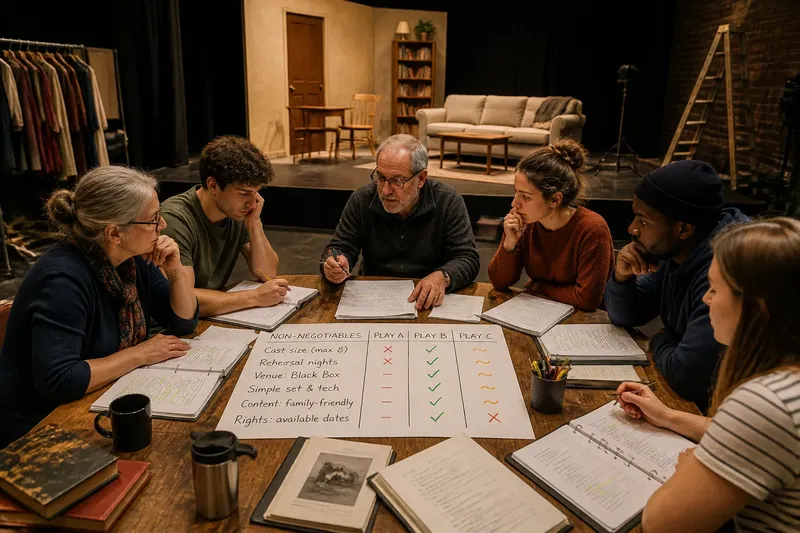
Three approaches cover most amateur productions. They can be combined, but choose one as the main shape of the session so that people know whether they are checking specific moments or running the whole sequence.
Should you use a cue-and-transition check?
This approach suits a small cast, a simple set, or a company that has already rehearsed the show in order. Visit the cue points and scene changes that involve several people, then confirm the signal and the person who acts on it.
It is especially useful when the main uncertainty lies in handoffs: who moves a chair, who calls a sound, or who waits for a clear entrance. It is less useful if the company has not yet experienced a continuous run and does not know where its shared rhythm breaks down.
Is a full run with brief holds a better choice?
A run with brief holds suits a company that needs to feel the whole evening’s flow while still having a chance to confirm a practical detail. The stage manager or director can pause at an agreed point, settle a cue or transition question, then restart from a clear place.
Use this sparingly. Frequent stops make it hard to feel the sequence, and long discussions can turn the run into scene work. If a problem needs substantial creative attention, record it for later rather than trying to solve it in the middle of the final check.
Would a handoff rehearsal fit a large or busy production?
A handoff rehearsal suits a production with backstage crew, musicians, front-of-house coordination, or several people sharing responsibilities. Walk through who gives each signal, who receives it, and who confirms the next action is ready.
This option can be more useful than repeating scenes that are already settled. It asks the company to rehearse the practical cooperation around the performance, including what happens when a person is briefly unavailable or a cue arrives late.
Choose by naming the likeliest source of confusion. If it is a few specific moments, use a cue-and-transition check. If it is the overall flow, run the show with limited holds. If tasks pass among many people, rehearse the handoffs. A mixed session is fine, provided its main purpose stays clear.
What belongs on the final rehearsal checklist?
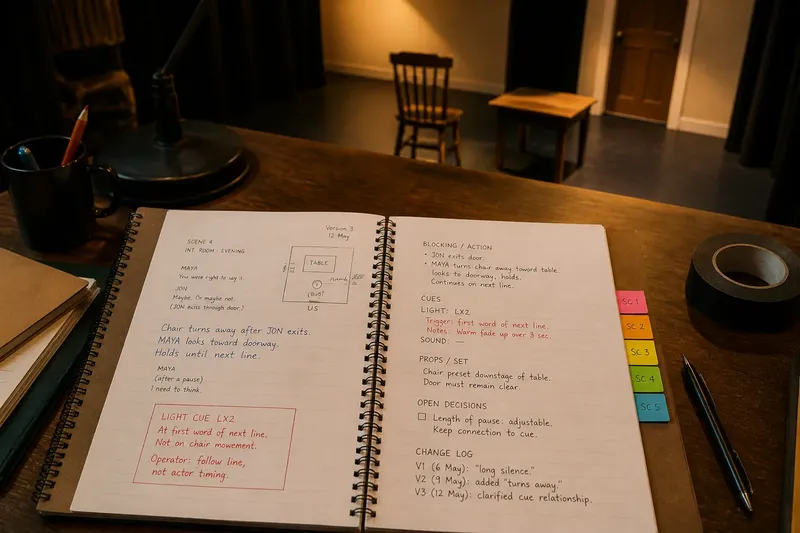
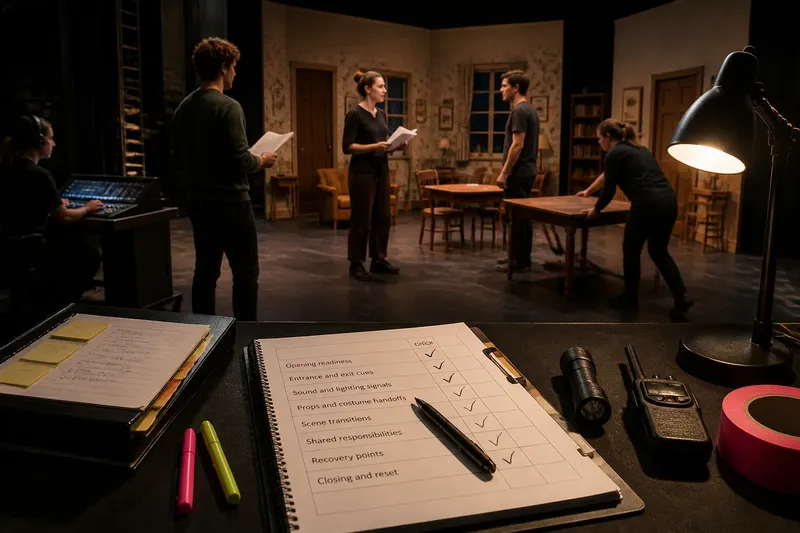
Keep the list in the stage manager’s prompt book or on a single printed page that the relevant people can see. Mark each item as confirmed, needs a decision, or not relevant. A short list that prompts a clear decision is more useful than a long inventory nobody can finish.
- Opening readiness: Confirm who checks the cast, stage, props, and sound before the opening cue. Agree how the stage manager will know each area is ready.
- Entrance and exit cues: Confirm the cue that sends each actor on or off, especially when an entrance depends on a line, sound, or movement elsewhere.
- Sound and lighting signals: Check the established cue words or actions, who calls them, and how the operator responds if a cue is missed. Do not add effects simply to make the sequence feel busier.
- Props and costume handoffs: Confirm where key items wait, who returns them, and who checks an item is ready for its next use.
- Scene transitions: Confirm the people responsible for each move, the order of the move, and the signal that the stage is ready to continue.
- Shared responsibilities: Name a backup for duties that cannot be left unattended, such as passing a message or confirming a backstage area is clear.
- Recovery points: Agree what the company does if a line, cue, or transition is missed: who gives the next useful prompt, and where the action can safely resume.
- Closing and reset: Confirm who checks the stage and props after the final moment, and how the space is left ready for the next use.
Labels, equipment instructions, venue procedures, and local rules may determine how some tasks are handled; follow the applicable directions rather than improvising around them.
How can you check cues without creating new work?
Ask each person to describe their cue in plain language. “I go after the bell” may sound clear until the bell is played by an actor, repeated in the sound, or missed altogether. A stronger shared description identifies the agreed signal and the person who confirms it.
Then check the chain around the cue. The actor who gives a line may be waiting for a light change; the operator may be waiting for a word; the stage manager may be watching both. Confirm which signal actually starts the next action, rather than leaving people to infer it from a general sense of timing.
For a transition, agree on a visible finish condition. That might be a chair in its marked place or a clear entrance path. The person responsible can give the agreed “ready” signal once the condition is met. Avoid adding a second signal unless it solves a real confusion.
Say you have a short scene change involving two actors and one volunteer moving a table. The actors agree to clear the stage after the final line, while the volunteer waits for a nod from the stage manager before moving the table. If the table is not in position, the actors hold at the established pause rather than inventing a new line or rushing the volunteer. That gives everyone an observable next action without changing the scene.
What questions should the company settle?
What should we do if a cue is missed?
Agree on the next safe, intelligible point where the performance can continue. The person leading the sequence should give the established prompt, and others should avoid talking over it or improvising extra signals.
Who confirms that a transition is ready?
Name one person to give the agreed ready signal, even if several people help with the move. A single confirmation keeps the next entrance from depending on competing guesses.
How do we handle an absent company member?
Confirm who covers any essential responsibility and what information that person needs. If no capable replacement is available, simplify or pause the affected action rather than assuming an unbriefed person will manage it.
When should we stop discussing a small issue?
Stop when the company has a clear, workable decision and everyone affected can repeat it. If the issue is a preference rather than a blocker, record it for another production instead of reopening a settled choice.
What is not worth the effort at the last rehearsal?
Do not spend the session polishing every gesture, debating a minor wording preference, or testing an optional cue that the production can do without. Those tasks compete with the checks that depend on several people understanding the same plan.
There is also little value in asking the entire company to recheck every prop and cue when only a small group handles them. Gather the people responsible, make the decision visible to anyone who needs it, and let others use the time to confirm their own entrances and responsibilities.
A final rehearsal checklist for an amateur theatre production should leave the company with fewer open questions, not a longer wish list. Pick the rehearsal approach that matches the likeliest handoff problem, confirm the agreed cues and transitions, and give each shared task a named owner. When the room clears, the most useful thing to carry forward is a simple, common understanding of what happens next.