Run-Through or Scene Work: Two Rehearsal Modes
Run-through or scene work? Choose the rehearsal mode that reveals whether your company needs the shape of the whole play or time to solve one passage.
A run-through shows whether a play holds together; scene work gives a difficult passage room to change. For amateur theatre rehearsals, choosing between these modes is less about which is better and more about what the company needs to see next. The useful question is simple: do you need a view of the whole, or time to solve a specific moment?
These modes serve different purposes, even when both involve performing the script. Use a run-through to notice patterns across the play. Use focused scene work to address a problem closely enough that actors and director can make a playable adjustment. The numbered choices below can help you decide how to spend the room’s attention.
How do you choose the rehearsal mode?
- Use a run-through when the question belongs to the whole play. Choose continuous performance when you need to see how scenes connect, whether the pace changes naturally, or if the story’s emotional shape comes through. A scene can feel lively in isolation yet lose momentum after a long transition or a quiet stretch. Only moving through the play can show that larger rhythm.
- Use scene work when one passage needs a specific answer. If a scene’s objective is unclear, a cue keeps slipping, or a shift in tone feels unearned, pause the larger flow and work on that passage. The director can ask what each character wants, what changes during the exchange, and what action could make that change visible. The focus stays on a solvable question rather than a general wish to “make it better.”
- Match the mode to the decision you need to make. Before calling actors in, finish the sentence: “By the end of this session, we need to know whether…” If the ending lands after the preceding sequence, a run-through may help. If a single confrontation has no clear turning point, scene work is more direct. A well-chosen mode makes the next decision easier to name.
When does a run-through give the clearest view?
- Run the play when isolated scenes are hiding a pacing problem. Separate rehearsals can make every scene seem substantial because each receives concentrated attention. In sequence, the same material may feel repetitive, or an important scene may arrive before the audience has had time to absorb what came before. A run-through helps the company notice the cumulative effect without stopping at every small imperfection.
- Use a continuous pass to check transitions and entrances. A transition is not merely the time between dialogue. It includes who clears a chair, where a prop is left, how the next group enters, and whether the stage picture changes in a way the audience can follow. Running scenes together lets actors experience those handoffs in context. Keep the questions practical: did the next moment begin clearly, and did the change interrupt the action?
- Run when actors need to feel the arc, not inspect each line. A character’s energy may rise, retreat, and rise again across several scenes. If the company keeps rehearsing each section separately, performers may miss that larger progression. A run-through invites actors to carry choices forward and see how one scene affects the next. It is especially helpful when the company already knows the basic blocking and needs continuity.
- Choose a run-through when interruptions would obscure the evidence. A director may be tempted to stop for every stumble, but frequent pauses make it hard to judge whether a quiet section truly drags or whether a transition is confusing. Set a narrow purpose for the pass, such as tracking the flow of entrances or the changing energy. Note observations for later instead of turning every moment into an immediate correction.
When is focused scene work the better use of time?
- Return to a passage when the actors cannot name its action. A scene may contain clear words but uncertain behavior: characters stand and talk without pursuing anything, or every line receives the same emphasis. Scene work can begin by identifying an active intention, such as persuading, concealing, or delaying. Actors can then try choices that make the intention visible through timing, focus, distance, and response.
- Isolate a turning point that does not yet register. If a character changes their mind, reveals a secret, or loses control, the audience needs to perceive that shift. Work around the line or action where the change happens. Try different ways of preparing it, and notice which choice gives the moment a clear cause and effect. The aim is not to add a dramatic gesture automatically; a small pause or a changed focus may be more truthful.
- Use scene work to repair a difficult handoff between actors. A cue can be technically correct yet feel unresponsive if one actor is waiting for a word instead of listening to the thought behind it. Focus on the exchange: what does the first actor offer, and what does the second actor receive or resist? Repeating a short stretch with attention on listening can make the dialogue feel connected rather than recited.
- Work in close detail when a physical moment needs clarity. A shared glance, a passed letter, or a character choosing not to sit can carry meaning that spoken text does not spell out. Focused rehearsal lets actors explore where the object or movement belongs in the scene and whether it supports the relationship. Keep the action simple enough to repeat consistently, rather than adding business that distracts from the dramatic point.
What should you watch for during each mode?
A run-through is an observation pass, not a race to finish the script. Watch for patterns that appear across the whole: energy that fades in the same kind of scene, repeated pauses that break the flow, or transitions that leave the stage inactive. Write brief notes with a scene or cue attached so the company can return to the relevant place later. Avoid collecting vague judgments such as “more exciting.” They do not tell actors what to try.
In scene work, keep the question smaller. Decide what the moment must communicate, then explore actions that might make it clear. The director can give one playable adjustment at a time: address the other character directly, hold the response until the thought has landed, or place the prop where it affects the exchange. After a try, ask what changed for the actors and what an audience might be able to read. Do not pile several new notes onto the same attempt.
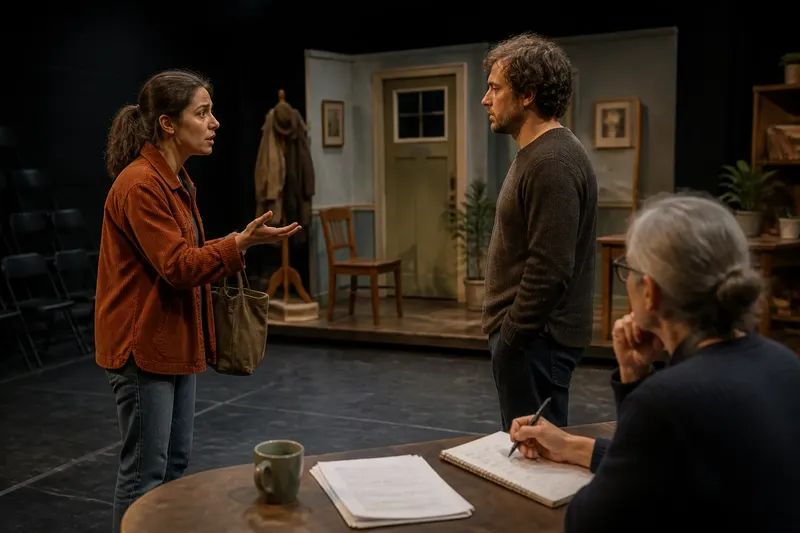
Say a community company is rehearsing a scene in which a neighbor asks for help, then leaves before receiving an answer. Imagine that the scene plays clearly in isolation, but a run-through reveals that the next scene begins so quickly that the neighbor’s departure has no consequence. The director could mark the transition as a whole-play issue, then use focused scene work to explore whether the unanswered request changes the remaining character’s behavior. The expected observable result is a transition that carries the decision forward, not a new speech or an invented pause without purpose.
It is not worth stopping a run-through to polish every line, and it is not worth repeating a scene without a question to test. Those habits consume attention while leaving the central uncertainty intact.
Which rehearsal mode answers these common questions?
Should actors hold their scripts during a run-through?
That depends on the company’s stage of rehearsal and the purpose of the pass. If the goal is to see pacing and transitions, actors may use scripts as needed, while the director notes where attention shifts from the scene to the page. If the goal is to assess how fully actors can carry the play, choose a form that matches what they have been asked to prepare.
Can a run-through include pauses?
Yes, if a pause serves the stated purpose, such as resolving a practical interruption that prevents the company from continuing. For an observation pass, save ordinary acting notes until the end so the flow remains visible. Tell the company beforehand which kinds of interruption are allowed.
How long should scene work last?
Give it enough time to try a clear choice, observe what changes, and decide whether the adjustment is useful. The passage may need another session if the question remains open, but repeating it without a fresh intention is unlikely to help. Let the dramatic problem, not a fixed duration, determine when to pause.
Should the director give notes during a run-through?
Usually, keep notes short and save them until the pass ends. An immediate note can be useful when a practical issue makes it impossible to continue or when the company has agreed to stop for a specific reason. Otherwise, a record of the moment preserves the run’s overall shape for discussion afterward.
How can you move from one mode to the other?
Let one mode identify the need for the next. A run-through may reveal that a confrontation loses its force; scene work can then examine the change in intention, the listening, or the timing that might strengthen it. After the focused session, return to the larger sequence to see whether the adjustment works in context. The two modes are not competing approaches. One brings a problem into view, and the other helps the company work on it.
For a useful handoff, end scene work with a specific choice the actors can carry into the next pass. Then note whether the choice clarifies the moment without making the surrounding play feel overworked. If it does not, the answer may be to simplify it, not to add another layer. Run-through or scene work becomes an easier decision once the company can say what it needs to understand next: the shape of the whole play, or the behavior inside one passage.